
Nanotechnology is revolutionizing multiple industries. What is it and where did it start?
Nanotechnology is relatively new in agriculture but is being studied and used across multiple fields including science, mechanics, electronics, biology, and medicine. According to the National Nanotechnology Initiative (NNI), “Nanotechnology is science, engineering, and technology conducted at the nanoscale, which is about 1 to 100 nanometers.” In 1959 physicist Richard Feynman introduced the concept of nanotechnology as a way to manipulate and control individual atoms and molecules. However it wasn’t until 1981 that high-powered microscopes were invented to be able to visually see and manipulate materials at a nanoscale. To get an idea of just exactly how small a nanometer is, the NNI states, “On a comparative scale, if the diameter of a marble was one nanometer, then the diameter of the Earth would be about one meter. There are 25,400,000 nanometers in one inch.”
In modern medicine, nanoparticles are being used for the targeted delivery and controlled release of therapeutic agents, minimizing side effects and reducing dosage. Nanotechnology has paved the way for commercial products such as clean drinking water, computers, smart applications, cleaner packaging and surfaces, and more efficient solar products.
The beginnings of a revolutionary technology by Aqua-Yield®
An entrepreneur at heart and sod farmer on his family farm, Clark Bell heard that a friend was using nanotechnology to enhance his dry-cleaning business and wondered if nanoparticles could improve farm production and increase nutrient efficiency. The trials his father Warren Bell conducted saw significant improvement over industry standards. From there, Warren and Clark met Fraser and Mike Bullock, investors who love to back science-based companies. Together, they incorporated Aqua-Yield® and formed an investor group, including sod growers from Australia, Canada, Norway and South Africa. The company filed its first patent and discovered new liquid nano applications for agriculture.
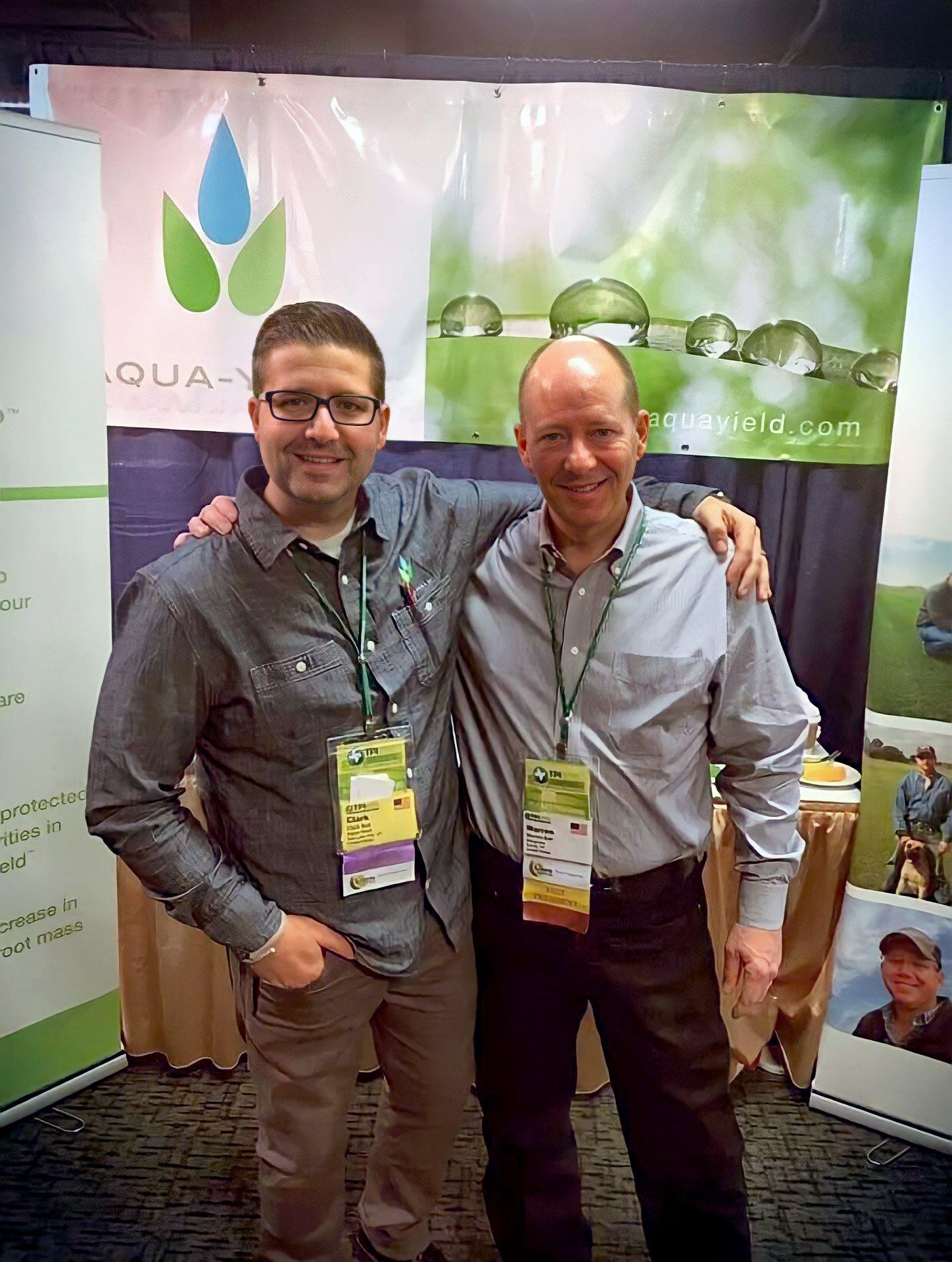
Founders of Aqua-Yield Clark and Warren Bell
The technology behind Aqua-Yield: the nanoliquid company
Aqua-Yield's proven, patented nanoliquid technology encapsulates the inputs you already use into tiny nanoparticles that glide through foliar and root barriers, lodging themselves in the right locations within a plant to deliver their payloads. Aqua-Yield nanoliquids effectively work as a delivery system for nutrients and crop protection products. The nanoliquid technology protects molecules from environmental losses and efficiently delivers them to plants at the cellular level.
Nanoliquid Encapsulation: Loading particles
Each of the Aqua-Yield nanoliquid products are specifically designed to function in a way to meet certain needs of a growing crop. Through a process of electrical charges and diffusion, nanoparticles are loaded with hundreds or even thousands of nutrient molecules. The nanoparticle works as a shield to protect the molecules and act as a nutrient delivery vehicle. When a nanoliquid is added to the fertilizer solution in a tank, the nutrient molecules of the fertilizer are immediately attracted to the nanoparticle and form an outer layer. For example, a negatively charged particle will attract potassium or calcium.
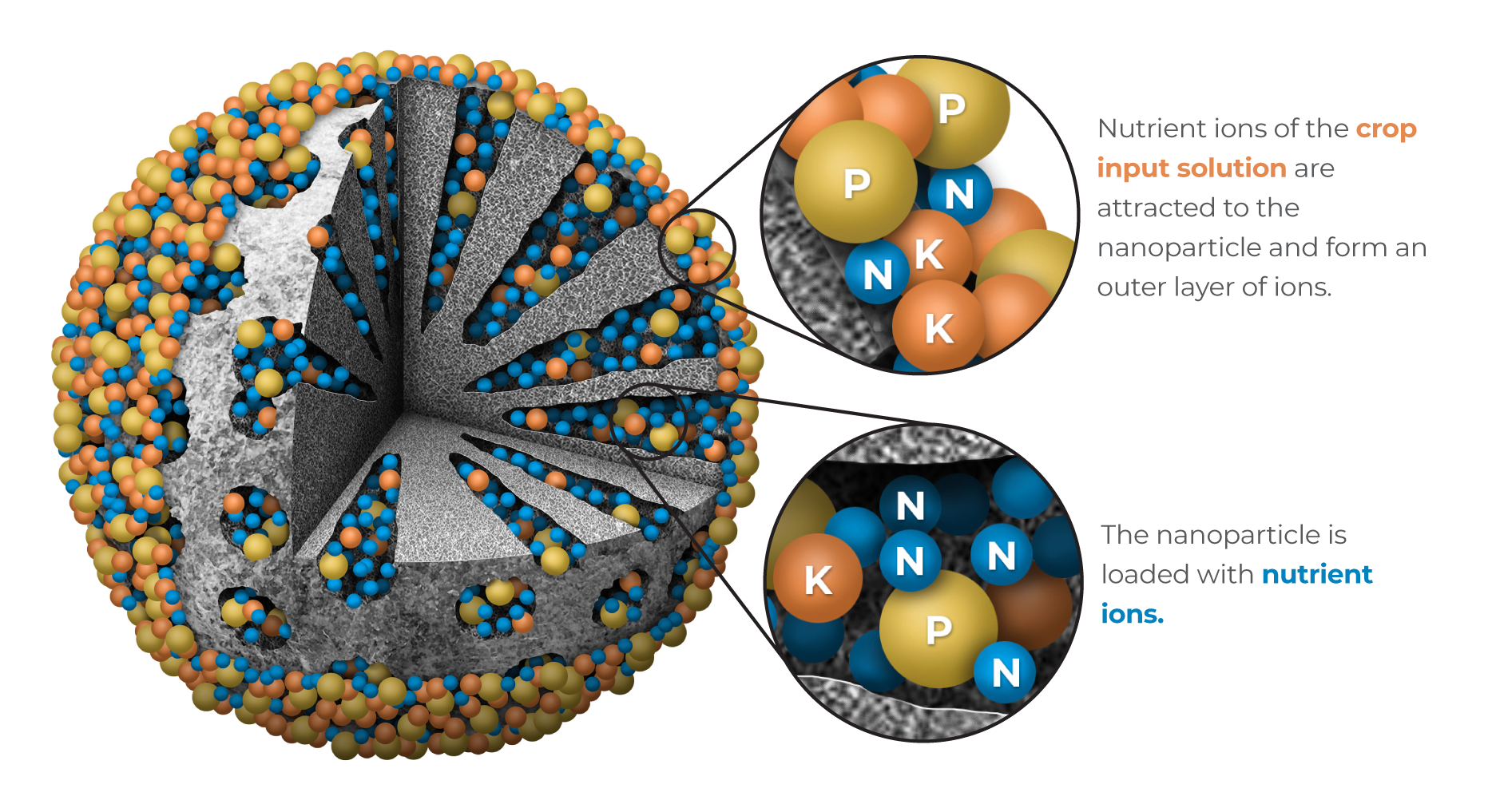
NanoPro and NanoN+ are considered unloaded, so when introduced into a crop input, the molecules will immediately load into the nanoparticle for transportation. NanoPro is a nanoliquid with empty nanoparticles, engineered specifically to hold the varying sizes of crop protection molecules for efficient delivery.
Nutrient and crop protection chemistries must cross multiple barriers before entering a cell, including the cell wall and plasma membrane. However, soil conditions, the availability/quality of input, and placement also play a factor IF and when a plant will absorb the input; the plant needs to be in the right “mood” in order to receive these inputs. Liquid nutrition moves through the soil solution until absorbed through root hairs or lost to the environment. Unshielded inputs often leech or tightly bind to the soil, remaining unavailable to the plant. When foliar applied, liquid inputs easily run off plant surfaces.
Diffusion vs Endocytosis 101
Typically plants process inputs through various forms of passive transport by diffusion. Passive transport does not require energy to move substances across plant cell membranes, relying on the second law of thermodynamics to drive the movement of substances across cell membranes.
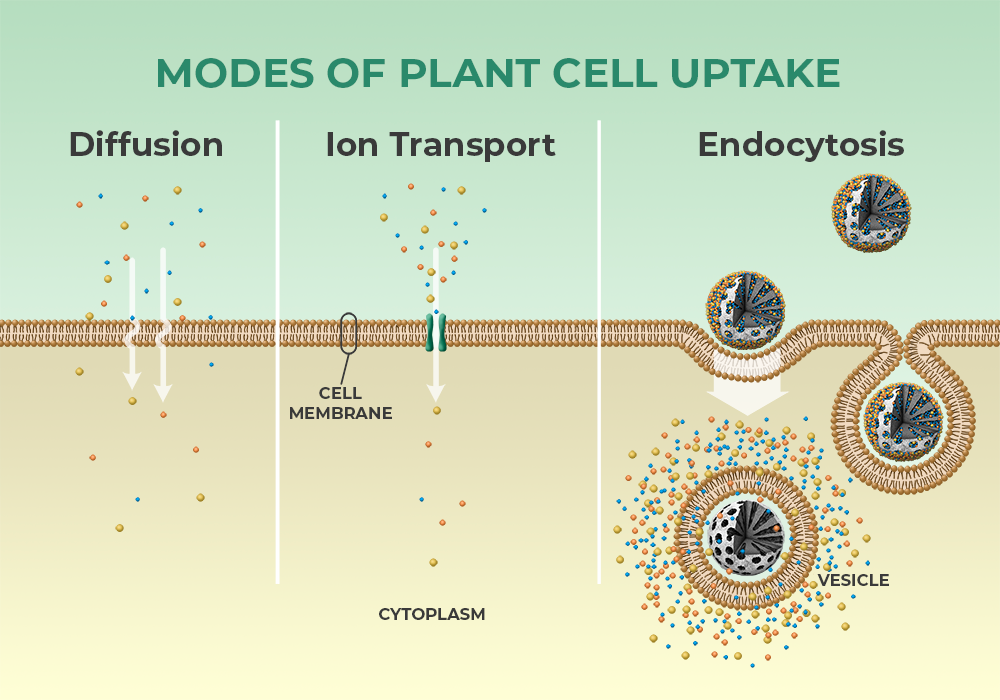
Aqua-Yield uses a different process called endocytosis to bring the loaded nanoparticles into the cell where the “payload” is delivered. Endocytosis is a means of bulk transport in which the cell uses energy (ATP) for substances that cannot be diffused across the plant membrane. More specifically, pinocytosis is the way a cell processes incoming fluids, known as “cell drinking”. The cell membrane receives the nanoliquid by engulfing it, creating a cavity filled with extracellular fluid and then forming a vesicle. The vesicle then breaks off and is transported within the cell.
When soil applied, the nanoparticles stay in solution or loosely cling to soil colloids, remaining available to deliver nutrients to the plant. Electrostatic forces draw the particles forward, and through the lightly negative-charged cellulose-rich cell wall of crop tissues. When foliar applied, the nanoparticles adhere to the plant surface in preparation of crossing through the cuticle, cell wall, and plasma membrane.
The most notable difference is that through the process of endocytosis, one nanoparticle can deliver a thousand nutrient ions, whereas in the process of diffusion each nutrient ion must individually pass through the cell membrane. It is for this reason that the concentrated nature of the Aqua-Yield nanoliquids allows for much lower application rates (ounces) than a conventional liquid fertilizer (gallons).
For more information, contact your Aqua-Yield representative or call/text or fill out the form below.
Have a question or want to learn more? Fill out the form below: