
How do nanoliquids work?
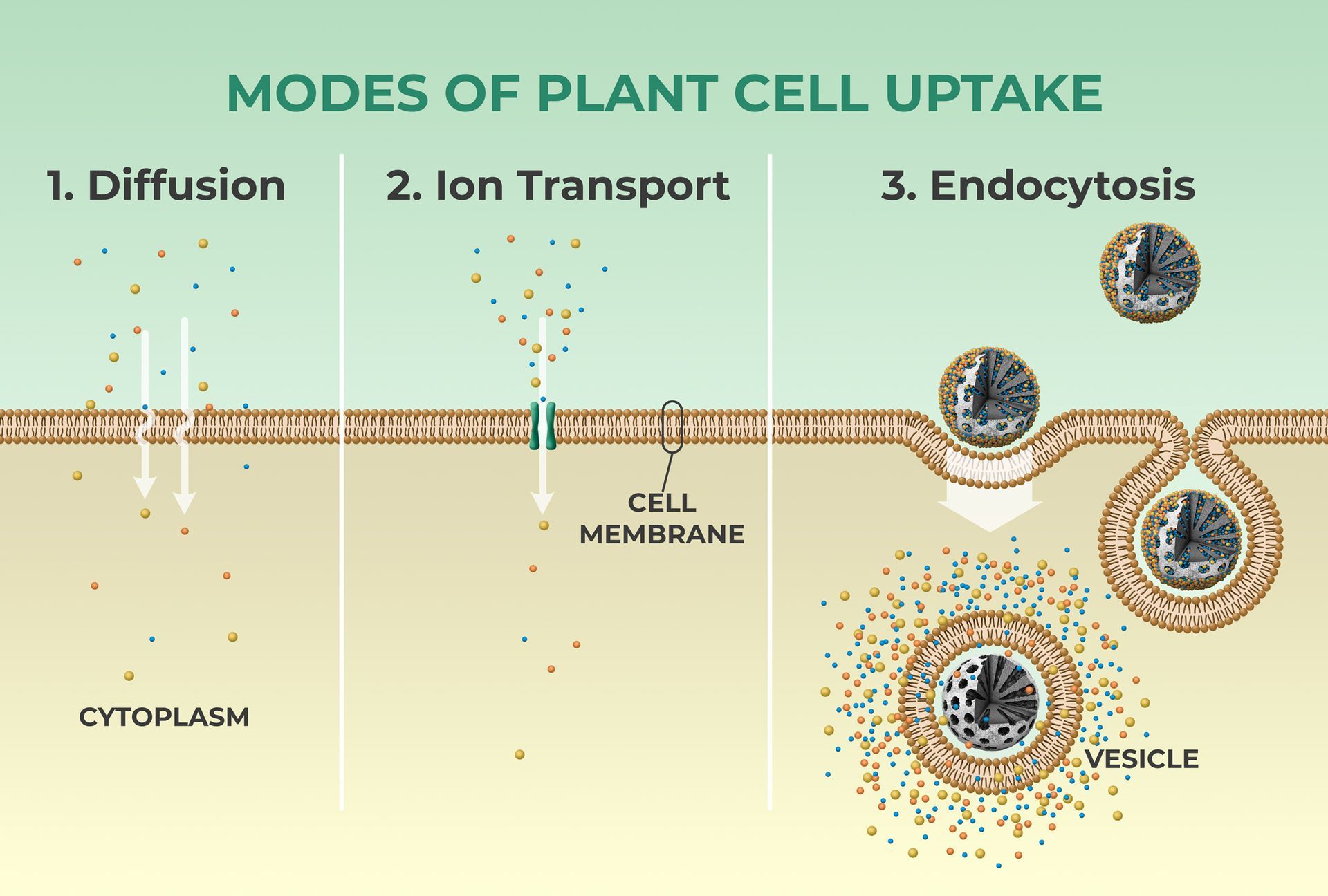
TNT ™ nanoliquid ™ products effectively work as a delivery system for both nutrients and plant protection products. The nanoparticle protects molecules from environmental losses and efficiently delivers them to plants at the cellular level. A biological process called endocytosis engulfs and brings the nanoparticles into and through the cell membrane where the “payload” is then emptied.
What is nanoliquid technology?
Nanoliquid technology is proven and patented; it encapsulates the inputs you already use into tiny nanoparticles that glide through foliar and root barriers, lodging themselves in the right locations within a turf plant to deliver their payloads. Nanotechnology is relatively new to the turf industry but is being studied and used across multiple fields including science, mechanics, electronics, biology, medicine and agriculture.
How do nanoliquid particles load and unload?
Particles can load in a couple ways:
- Electrical charges play a role where opposites attract. Some particles can be negatively or positively charged to attract desired nutrients. For example, a negative charged particle will attract potassium or calcium.
- Diffusion is where areas of high concentration move to areas of low concentration. For example, a liquid 16-3-5 fertilizer in solution will migrate into empty nanoparticles when NanoBoost™ is added to the tank. This process “loads” the nanoparticles, which are now ready for delivery to the plant.
The processes above operate in reverse “unloading” once inside plant cells.
Are TNT nanoliquids organic?
Short answer is no. While TNT promotes environmental stewardship through nanoliquid technology by enhancing uptake, its silica mineral composition is not considered organic.
What are TNT nanoparticles made of and where do they come from?
Nanoparticles are defined as mesoporous silica-based nanoscopic spheres, or particles (~100nm and less). We source mined Zeolites from ancient volcanic formations and then process them to our exact specifications, rates, and sizes. More simply, think of them as “mineral sponges'' with a high affinity for absorbing other molecules added to spray solutions.
Have a question or want to learn more? Fill out the form below: