
Introduction
NanoCote™ Core claims to be a revolutionary product that increases crop yield when mixed into conventional fertilizers. But is Core really that good? NanoCote has conducted numerous tests to show the difference in adding NanoCote Core and industry-standard fertilizers alone.
Nitrogen Stabilization
Nitrogen is an essential nutrient for plants and is required in large amounts. However, conventional fertilizers' nitrogen is susceptible to losses due to various natural processes. The more nitrogen the fertilizer loses, the less available it is to the plants, and thus reducing yields. By stabilizing nitrogen, farmers can achieve better yields with the same amount of fertilizer or maintain yields while reducing fertilizer inputs.
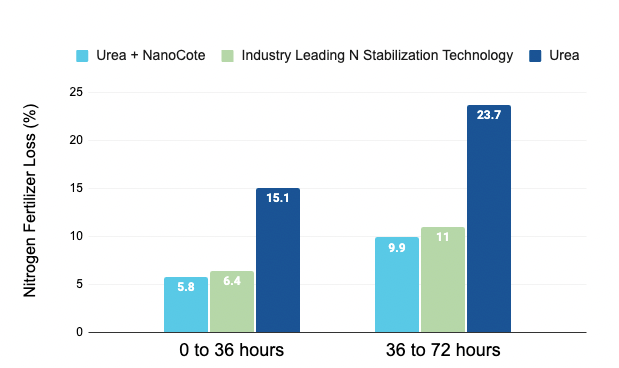
To test Core’s nitrogen stabilization capabilities, NanoCote compared Core against three different fertilizers: Standard Urea, Nitrogen Stabilization Technology, and Urea mixed with NanoCote Core. All three fertilizers were tested to see their rate of nitrogen loss (expressed as a percentage) over 36 and 72 hours. The results are as follows:
36 Hours
- Standard Urea: 15.1%
- Industry Leading Nitrogen Stabilization Technology: 6.4%
- Urea with NanoCote Core: 5.8%
72 hours
- Standard Urea: 23.7%
- Industry Leading Nitrogen Stabilization Technology: 11.0%
- Urea with NanoCote Core: 9.9%
NanoCote Core is designed to improve crop yields across the spectrum. So as long as it is added to your conventional fertilizer mixture, crop yields are expected to increase. NanoCote conducted three trial experiments using standard and Core-treated fertilizer to test this. Both fertilizers were applied to three different plant groups: Alfalfa in the Pacific Northwest, potatoes in the Northwest, and Corn in the Southeast. The results of the experiment are as follows:
- NanoCote Core: 4.6
- Standard: 4.2
- NanoCote Core: 3.4
- Standard: 3.1
- NanoCote Core: 4.5
- Standard: 4.0
- NanoCote Core: 2.0
- Standard: 1.9
- NanoCote Core: 14.4
- Standard: 13.2
- NanoCote Core: 22
- Standard: 20
Corn in the Southeast (Measured in bushels per acre)
- NanoCote Core: 194
- Standard: 186
Results show that NanoCote Core improves crop yields across the board. With Core, you can produce more crops than conventional fertilizers, which means a higher ROI.
Sod Production
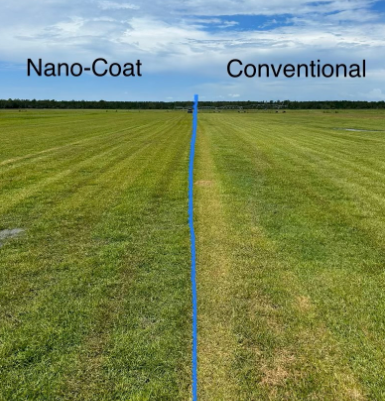
One of the last tests NanoCote conducted was to show that Core can increase sod production in grass. NanoCote tested two sides of a centipede grass field in a sod farm in Ocala, Florida. One side was treated with fertilizer mixed with Core, and the other was treated without Core. After three weeks, visible differences began to show. After four, the differences became stronger. The grass treated with Core looked darker and healthier than the side treated with conventional fertilizer.
Conclusion
Core’s results clearly show that it is not just another empty promise product itching to snatch a dollar out of your fingers. Core works. It performs on every level to ensure you get the most out of the resources you purchase. With cutting-edge technology and research, NanoCote has developed a product that delivers results.
Have a question or want to learn more? Fill out the form below: